
How Configurix connects manufacturers, dealers and customers in 3D
Keep one approved product model while giving each dealer the right catalogue, pricing context, brand and quote workflow. See how Configurix connects the journey.
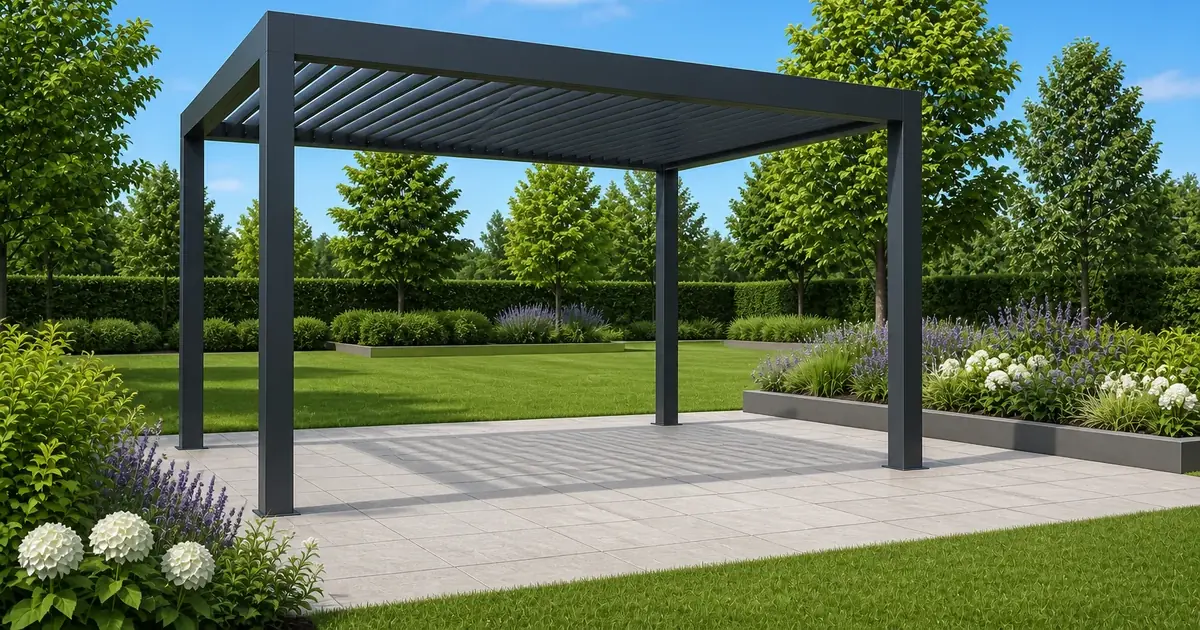
Table of contents
- The problem is not that dealers lack a 3D image
- One product truth, different sales responsibilities
- Follow one pergola project through the network
- Where Configurix is stronger than a disconnected dealer portal
- A shared platform does not mean every dealer gets the same price
- The principle works beyond outdoor products
- What to test in a Configurix dealer demo
- When is Configurix the right choice?
A manufacturer and its dealers should not have to describe the same product in three different systems. The customer sees one version online, the dealer prices another in a spreadsheet, and the factory receives a third by email. Even when everyone is careful, the handoffs make it harder to know which dimensions, options and quote were actually agreed.
Configurix connects those steps around one saved product configuration. The manufacturer defines the range and its rules; customers and dealers work through a guided 3D experience; the commercial result and the next action follow the same project. For manufacturers with a dealer network, that connected approach is a stronger choice than adding a visual widget while leaving the real sales process unchanged.
The problem is not that dealers lack a 3D image
Dealers need a product they can confidently sell. A good rendering helps a customer understand the choice, but it does not tell a dealer whether the selected dimensions are permitted, which accessories belong with the system, what the account is allowed to price, or whether the manufacturer has accepted a special condition.
The most useful question to ask of any dealer configurator is therefore: Does the product remain the same product as it moves between people? If a salesperson must rebuild the design in another application to create the quote, the answer is usually no.
Configurix is built to connect the visual experience to a structured product state. The selected model, dimensions, components and revision can remain visible to the next person instead of being flattened into a screenshot or a free-text lead note. Its dealer configurator software can then shape permissions, account-specific commercial context and branded outputs around the way your network operates.
One product truth, different sales responsibilities
The manufacturer should own what the product is. The dealer should be able to sell it in the context of its own account and customer relationship. The customer should see clear choices without being exposed to internal prices or approval details. These are different views of a connected journey, not three unrelated catalogues.
| Responsibility | Manufacturer | Dealer | Customer |
|---|---|---|---|
| Product range | Approves models, dimensions, options and market availability | Uses the range assigned to its account | Explores the products made available to them |
| Rules | Defines required, incompatible and review-only combinations | Follows the rules and raises an exception when needed | Gets guidance before submitting an invalid selection |
| Commercial context | Governs price sources and permissions | Sees the account prices, discounts or approvals its role allows | Sees only the price or quote status intended for the public journey |
| Project | Receives an agreed specification and channel context | Continues the customer conversation and owns the follow-up | Can save a design or request the next step |
| Quote or order | Controls accepted downstream fields and revision handling | Produces or requests the permitted proposal | Receives a clear offer tied to the selected product |
Configurix can be scoped so those differences are enforced through accounts and roles. That is more robust than handing each dealer a copied product file and hoping all copies stay current.
Follow one pergola project through the network
Imagine a customer designing a pergola on the manufacturer's website. They choose a wall-mounted system, set width and projection, select a louvered roof and pick a finish. The 3D view changes with the choices. Product rules guide which side elements or accessories are compatible. The customer saves the project and asks to speak with a local dealer.
The assigned dealer opens that configuration, not a blank form. They can check the dimensions, discuss a screen or lighting option, add any site information the customer could not know and see the commercial context their account is permitted to use. If installation needs a survey, the quote can say so. If a selection needs manufacturer review, the project can keep that status rather than presenting the exception as an automatically accepted order.
When the dealer issues a proposal, the selected pergola, price context, visual reference and revision stay connected. If the customer changes the roof or finish, the project has a new state that can be compared with the submitted version. The manufacturer receives the accepted product data needed for the agreed next step.
This is why Configurix matters to a dealer network: the customer does not have to explain the product twice, and the dealer does not have to recreate it from an email attachment. See the pergola configurator for one product category; the same principle can be adapted to the rules of your own range.
Where Configurix is stronger than a disconnected dealer portal
A conventional portal may store PDFs and price lists. A basic 3D widget may show product variations. A CRM may record the contact. Each tool can be useful on its own, but a dealer still has to bridge the gaps between product, price and customer project.
Configurix offers a different starting point: the approved configuration is the common reference. The 3D view is a way to understand it; the price calculation is a commercial interpretation of it; the quote and project record point back to it. That architecture is particularly valuable when:
- A product has size-dependent options, required components or incompatible combinations.
- Different dealers have different catalogues, territories, price lists or approval permissions.
- A customer begins online but completes the purchase in a showroom or sales call.
- A quote must preserve the exact choices and commercial assumptions the dealer used.
- The manufacturer needs structured order, CRM or ERP fields instead of a picture alone.
Not every network needs all of those capabilities in its first release. Configurix can start with one product family and one clear dealer journey, then extend the catalogue and outputs after the first complete path works. The scope should follow the actual sales process rather than a generic portal checklist.
A shared platform does not mean every dealer gets the same price
One of the hardest parts of dealer selling is keeping product rules consistent while allowing commercial differences. A manufacturer may govern the model and its compatible options centrally, while an account-specific price list, currency, tax treatment, discount permission or brand identity varies by dealer or market.
Configurix can separate those concerns. The same structural product decision can be valid for two dealers while the price each may view or quote differs according to its account context. A public buyer may see an indicative amount or no amount at all. An internal approver may see the reason a discount or exception requires review. Those distinctions must be defined and tested during implementation; they should not be guessed from a screen mockup.
The result is a more credible sales experience: the dealer can present the manufacturer's approved product without exposing data intended for another account or promising a price that has not been authorized.
The principle works beyond outdoor products
Pergolas make the journey easy to visualize, but dealer networks also sell doors, windows, gates, garden rooms, industrial equipment and other configurable products. The choices and review conditions differ by range; the need for an accepted configuration and clear ownership does not.
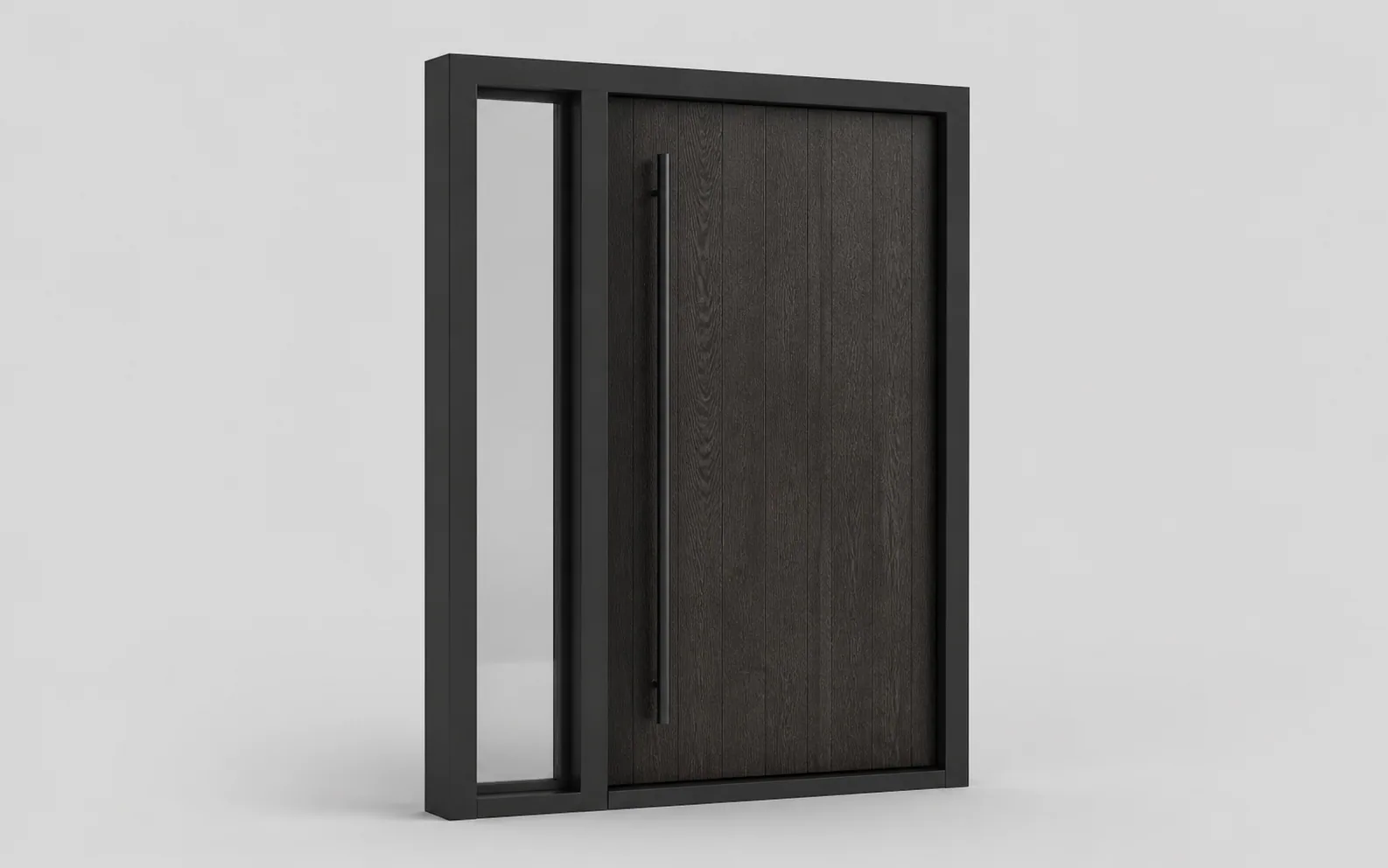 The same governed approach can apply to door ranges, with different dimensions, panels, glazing and hardware rules.Open full-size image (new tab)
A door manufacturer might control opening dimensions, panel construction, glass, security hardware and finish combinations. Its dealer may need a branded proposal and a site-measurement step before the order is final. Configurix can model that as a product-specific journey rather than forcing door options into a pergola-style interface. The manufacturer configurator platform explains how customer, dealer and internal-sales experiences can share a governed backbone.
What to test in a Configurix dealer demo
Bring one genuine product and one dealer account. Do not stop when the 3D product looks attractive. Follow the same project through these checks:
- Product assignment: Can this dealer see only the models and options it is authorized to sell?
- Rule behavior: What happens when a dimension or accessory combination is not allowed?
- Customer continuation: Can the dealer reopen the exact design the customer submitted?
- Commercial permissions: Which buy price, sell price, margin, discount or approval details are visible to each role?
- Quote identity: Does the proposal identify the selected product, commercial scope and saved revision?
- Change handling: If the dealer changes a selection, can the team still see what the customer originally requested?
- Next-system handoff: Which fields reach CRM, ERP or order processing, and what happens if that transfer is rejected?
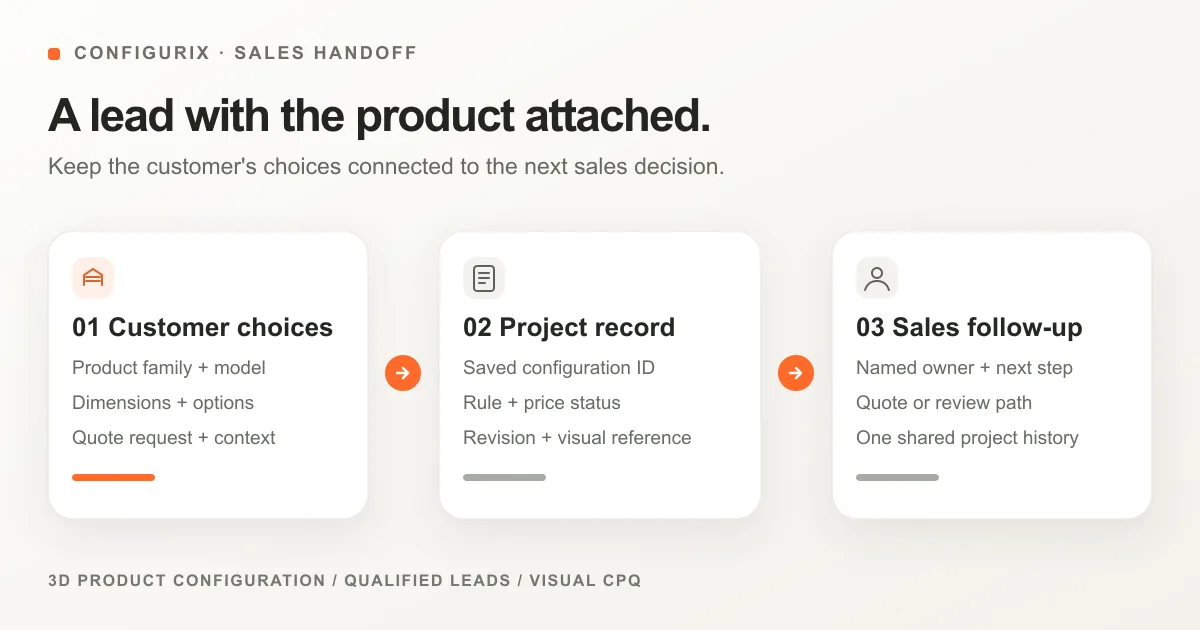
These are the tests that reveal whether a dealer configurator will actually reduce re-entry and ambiguity. Our guide to a sales-ready configurator lead gives a more detailed field map for the customer-to-sales handoff.
When is Configurix the right choice?
Configurix is a strong fit when your dealers sell products with meaningful choices, your catalogue or prices differ across accounts, and your team needs the selected product to remain usable after the first visual interaction. It is especially compelling when a manufacturer wants customers, dealers and internal sales to work from one governed product model while keeping their responsibilities distinct.
If every dealer sells a small set of fixed SKUs at public prices, a lighter ecommerce catalogue may be enough. If your product requires unrestricted engineering design on every order, a guided configurator should qualify and structure the request while the engineering team retains final design authority. Configurix is strongest where guided product selling and the next commercial step need to work together.
That is a more useful promise than simply giving each dealer a 3D viewer. Book a Configurix demo with your product range, dealer structure and a real quote example. We will show where one product truth can replace disconnected sales handoffs in your network.
Show us how your dealers sell.
Bring one product range, your dealer price structure and a real quote example. We will map a Configurix journey around your network.
Book a dealer workflow demo →Related articles
Best 3D configurator for manufacturers? Why choose Configurix
A manufacturer-focused case for Configurix: connect governed product rules, interactive 3D, pricing, quotes and dealer or sales handoffs in one configurable journey.
Parametric pergola configuration: from live 3D design to a quote
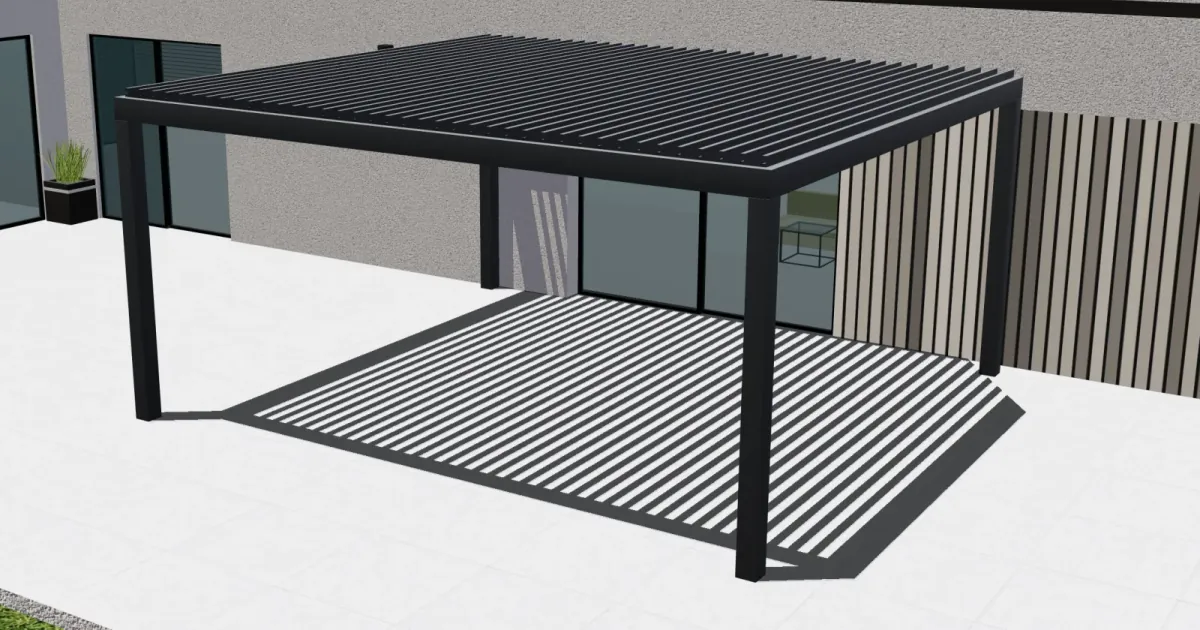
See how Configurix connects made-to-measure pergola dimensions, roof and side options, live 3D, pricing rules and a quote tied to the chosen design.
What a sales-ready 3D configurator lead should include
A practical field map and handoff test for manufacturers: keep product choices, dimensions, pricing status and quote intent attached to every configurator enquiry.
From pergola design to factory: BOM, CAD, cutting and CNC with Configurix
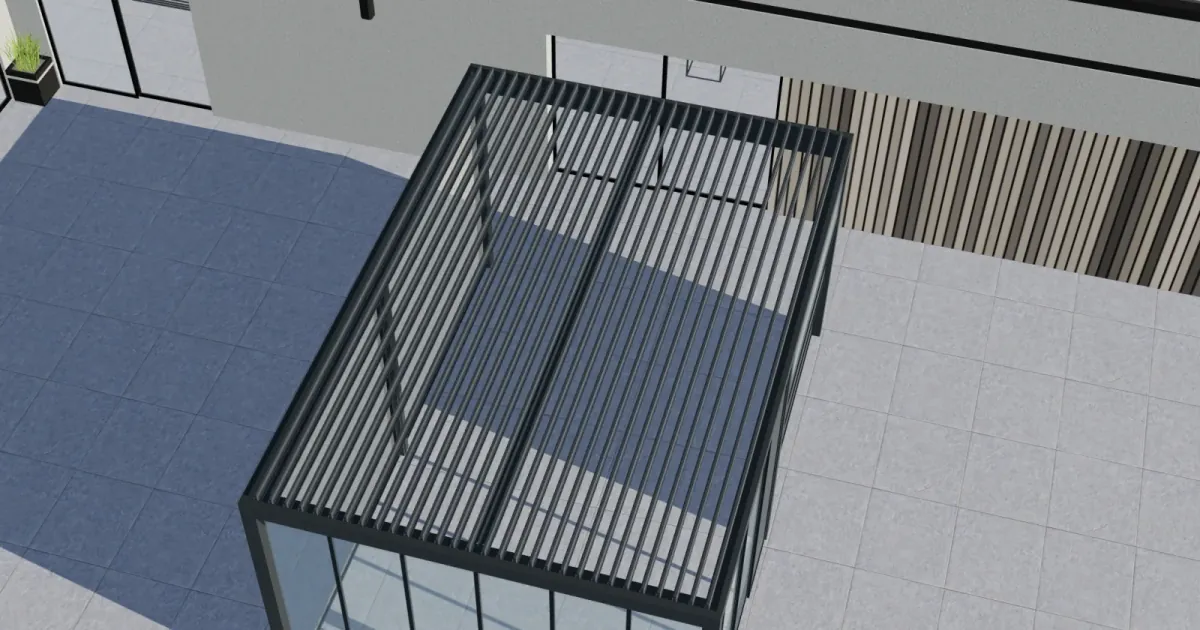
Follow a configured pergola from accepted 3D design to bill of materials, CAD-related data, production documents, cut plans and validated CNC handoff.